Tuesday, 21 May 2013

Cooking Banquet


Well, the where has the time gone!  Saturday May 25, I will be running another cooking class.  This time it is to be a banquet of sorts.  Over 4 hours the course participants and I will be preparing dishes from dips to BBQ kofta to mahshi and of course what better way to end than with a sugar high from sugar syrup drenched sweets.  I am really looking forward to Saturday and hope that the weather is kind enough so that we can enjoy our BBQ cooking outdoors.

I have also had a request via YouTube to make Koshery.  A carbohydrate loaded dish that is very popular in Egypt and served in restaurant setting as well as "fast food".  This dish is typically Egyptian even though it is known all over the Middle East.  My father said the most commonly asked question asked of him when he had his shop which sold all kinds of products commonly used in Middle East cooking was"How do you make Koshery?".  I will endeavour to fulfil this request the week following the course so keep an eye out for that.

If you would like to keep up to date with the latest videos you can subscribe to my YouTube channel at :

If you have a request or a comment please feel free to do so either below or on YouTube and I will get back to you.

Monday, 22 April 2013

Meatballs in tomato sauce كفتة بالدمعة Kofta bil dema-a


I was looking through the massive amount of cooking footage I still have on the computer and discovered a gem.  While our second child was still a baby and not a toddler I made Meatballs in tomato sauce   كفتة بالدمعة  Kofta bil dema-a.

I have always enjoyed eating good tasting meatballs and Kofta  كفتة   is basically an Egyptian meatball.  Kofta can be made so many different ways and it can be fried, or barbecued  or cooked in a tomato based sauce and left to simmer away absorbing flavours on the stove (or this can be done in a slow cooker).  

The key, as with any type of meatball, is to make sure they are browned first as this seals the meatballs and stops them from falling apart in the cooking process.

When I went back and watched the footage I got to reminisce and enjoy those memories from when the kids where so little.  I think this must be one of my favourites, if not my favourite video.  Take a look and let me know what you think...oh, and the food too!


We always had Meatballs in tomato sauce   كفتة بالدمعة  Kofta bil dema-a with rice but I know that many people eat meatballs with pasta.  These could easily be eaten served over pasta if you like.  But at home it was rice.  I love the rice soaking up the sauce and I often used to mush up the meatballs and stir it all together through the rice.  I do that for the kids and they love it.  

As with most things feta cheese, olive and a green salad at the table and it is a complete meal.

Love to have your feedback so let me know how you go making this.


Meatballs  كفتة  Kofta
Kofta Barbecued

Meatballs  كفتة  Kofta
Fried Kofta

Meatballs in tomato sauce   كفتة بالدمعة  Kofta bil dema-a
Meatballs in tomato sauce   كفتة بالدمعة  Kofta bil dema-a

Tuesday, 16 April 2013

Pulses and grains

It has been a while since we had some vocabulary.


Bulgur

Today I thought we could focus on pulses and grains.


Pulses                                       Albekol                                                    البقول
Black eyed peas/beans            Fasolia Ein Sodah                            سوداء عين الفاصوليا
Broad (fava) beans                  Fasolia aredah                                        (فافاالفاصوليا
Grain (cereal)                          Hebob                                                       حبوب
Chickpeas                               Homoss                                                   الحمص
Lentils                                     Adss                                                          عدس
Rice                                        Roz                                                          الأرز
Vermicelli                               Shereiah                                                     الشعيرية
Pasta                                      Makarona                                                معكرونة 


Black eyed peas/beans            Fasolia Ein Sodah                            سوداء عين الفاصوليا


Black eye peas are soaked overnight then cooked with meat in a tomato based sauce.


Broad (fava) beans, Fasolia aredah, (فافا) الفاصوليا)
Broad (fava) beans, Fasolia aredah, (فافاالفاصوليا
Broad beans are used to make the ever popular Ful Medames.  Such a great way to eat broad beans, the slow cooked beans are then flavoured with oil, lemon, salt, garlic, and served with finely chopped onion, tomato, cucumber as well as feta cheese and eggs as an optional extra. For more details check out my previous entry (http://dynasegyptiancooking.blogspot.com.au/2012/07/slow-cooked-beans-ful-medames.html).


Rice was a staple in our household.  Made fresh almost daily to go along with pretty much anything.  We often used vermicelli as it can be fried in butter or oil before the rice and water is added.  As part of the rice dish, it adds colour and flavour.

Vermicelli     Shereiah    الشعيرية
Vermicelli     Shereiah    الشعيرية

Rice is served with most main dishes including Tabikh (dishes cooked in a pot on the stove).  Our equivalent of meatballs was served with rice rather than pasta, and while there are several dishes which contain other Carbohydrates such as pasta or potatoes, rice is still an accompaniment.

Rice    Roz    الأرز
Rice    Roz    الأرز

I still love eating rice, especially with salad and a simple dressing of oil, salt and lemon.  And feta cheese.
yum.


fata wi ros (Bread with rice)

Baked fish with bulgur grains

Grilled fish with red rice (Rice in tomato sauce)


Wednesday, 20 March 2013

Hummus bi Tahina حمص بالطحينة Hommus dip

Book 2 in the Egyptian Cooking series is now available from Lulu.  Click the Book shop tab at the top to link straight through.  The book is only $1.95 and I would love your feedback as always.

Well, the series of cooking classes came to an end last night.  I had a great time cooking and getting to know the ladies of the class.  The classes were interactive and fun with the ladies getting involved which was great. I hope that future classes will run as well and I look forward to even more Egyptian dishes becoming widely known.  I think that dips are fairly well known with a large number of dips being available in supermarkets and delicatessens.  Most of them are very easy to prepare at home and can be adjusted to suit your own tastes.

The dip Hummus bi Tahina   حمص بالطحينة  (Hommus dip) is great because it uses chickpeas which are a great source of calcium and vitamins E and B.  Serve it with fresh bread or crackers, batons of fresh vegetables or even use it as a spread for sandwiches.  This is quick to make and healthy too, what's not to like about that!

I have updated the Egyptian cooking videos so now you can click through to more videos through the menu at the top of the page.  The Hummus bi Tahina   حمص بالطحينة  (Hommus dip) is there too.

Hummus bi Tahina   حمص بالطحينة  Hommus dip

Hummus bi Tahina   حمص بالطحينة  Hommus dip


150g / ¾ cup / 5 oz. dried chickpeas
juice of 1 lemon
2 cloves garlic, crushed
salt, to taste
½ teaspoon ground cumin
ground paprika, to garnish
30 ml / 2 tablespoons olive oil
4 tablespoons/ 60 ml tahini paste (150 ml/ 2/3 cup/ ¼ pint tahini paste)

Put chickpeas in a bowl and cover with cold water and leave overnight.
Drain chickpeas, place in a saucepan and cover with fresh water.  Bring to the boil and cook on high heat for 10 minutes.  Reduce heat and simmer for 2 hours or until soft.  Drain.   Alternatively canned chickpeas can be used instead of dried.  Use 400 g and drain well.

Place chickpeas in a food processor and blend to a smooth consistency.  Add lemon juice, garlic, olive oil and tahini and blend until smooth. Taste and season as required.
Transfer to a bowl, garnish with paprika.

To watch the video click through below or jump onto Dyna's Egyptian cooking on YouTube.


Friday, 1 March 2013

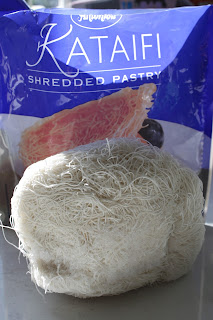
Konafa كنافة Kataifi

It has been a busy few weeks with running the cooking classes but I definitely do enjoy the time cooking and talking over cups of Hibiscus tea (Red tea كركديه Karkadé).

This week we made sweets and it was the first time I had made Konafa in a long time.  It was a big hit and it was all about to go before someone kindly put some aside for me to take home for the boys.  Naturally they were in bed when I got home but they did get to taste it the following day and my oldest son (nearly 5 and very much looking forward to "turning another number") tells me he liked it very much and asked if he could eat it all please.

What better recipe to put up than one which is crunchy on top, soggy through the middle, with the texture of the nuts and drenched with sugar syrup.

Konafa كنافة Kataifi is one of the easy Egyptian sweets that is delicious and quick to prepare.  My mum made this fairly often usually with nuts but the combination of nuts varied depending on what we already had in the pantry.  Usually walnuts, almonds and pistachios are used but you could add hazelnuts or other nuts if you prefer them.  Make sure they are unsalted, but there is no need to roast them or peel the skins off.

It is traditionally served with tea and coffee (which really does help cut through the intensity of the sugar in the Konafa).

Konafa كنافة Kataifi


Konafa كنافة Kataifi

Konafa كنافة Kataifi


To make the syrup:
1 ½ cups sugar
1 ½ cups water
half a lemon juiced
A few drops of vanilla extract, rose water or orange blossom water.

Combine the sugar, water and lemon juice in a small saucepan, bring to the boil, then reduce heat and simmer for 10 minutes or until it is thick enough to coat a spoon.  Leave to cool then add a few drops of vanilla essence or 1-2 teaspoons rose water or orange blossom water and stir.

Konafa كنافة Kataifi


375g / 1 packet shredded pastry or Konafa (Kataifi)
250g unsalted butter or ghee (clarified butter), melted
Konafa كنافة Kataifi
2 cups / 225g unsalted shelled pistachio, walnuts or almonds, coarsely chopped (or a combination)
¼ cup sugar
1 teaspoon ground cinnamon
½ teaspoon ground cloves
1 tablespoon sultanas or desiccated coconut, optional
2 tablespoons crushed pistachio, optional, to serve
One quantity of syrup.


Preheat oven to moderate 180°C (350°F/Gas mark 4).  

Combine nuts, sugar and spices in a bowl.  

Pull apart the Konafa and separate the strands into a bowl.  

Pour melted butter over Konafa and mix thoroughly with your fingers to coat and separate the strands.  

Put half the pastry into a large, deep, round dish, and flatten with the palm of your hand.  Spread the nut mixture evenly over it and cover with the remaining pastry.  Flatten the top again.  

Bake for 45 - 60 minutes or until the Konafa is golden in colour.  Remove the Konafa from the oven and turn out onto a baking tray and then again onto a serving plate.  Pour the cool syrup over the hot Konafa.  

Serve with crushed pistachio nuts. 

Note : Do not store in the fridge or it will go soggy.

Konafa كنافة Kataifi


Sunday, 3 February 2013

Dynas Egyptian Cooking eBook

Finally, I've completed my first eBook!

Its for sale on Lulu in PDF format.  Click on the link below to access the site.

http://www.lulu.com/spotlight/dynascooking

Book 1 Contents


Lentil soup عدس Aatz , page 4
Pita bread parcels حواوشى Howowshi, page 7
Bean salad سلطة فاصولياء Salatat faso-ley-a, page 10
Falafel فلافل Ta’meya, page 12
Stuffed vine leaves محشي ورق عنب Mahshi wara enab, page 16
Beef in stock لحمة بالشوربة Lahma bil shorba, page 22
Fried fish سمك مقلي Samak maquli , page 24
Rabbit ارنب Arnab, page 26
Butter pastry فطير Fit-ir, page 30
Basbousa with yoghurt بسبوسة بالزبادى Basbousa bil laban zabadi, page 33
Apricot pudding مهلبية بالقمر الدين Muhallabia bil amaradine, page 36
Stuffed dried figs تين محشي Tèen, page 38

With full colour photos and little anecdotes you will find it more than the usual cookbook.  I hope you enjoy.

Please feel free to leave comments or feedback on the book below.

Your in Cooking,

Dyna

Thursday, 31 January 2013

Prickly pear تين شوكى Teen Shawky


I plan to have my first Egyptian Cooking eBook up this week, so keep an eye out for that!
In the meantime, we had a kinder interview this morning for my son who will be in 4 year old kinder this year.  Very exciting.  We spent some time meeting the teacher that will be the biggest influence on our son outside of the home and getting the paper work out of the way.  We were then shown the ins and outs - literally, where we come in and go out etc. And then as if in a wink we were finished.  Armed with the knowledge we needed for the smooth transition into the first week of kinder.  The kids were content and since we were already out and about and it was just on 9 am I thought we would head to the market. 
I was actually trying to source figs since I have used up all the fig jam I made last year (I really do think it is the best thing on fresh bread with butter).  I had fig jam on toast this morning and have enough left for about two more slices.  That’s it.  Being so critically low was my motivation for finding figs in a quantity and price that was conducive of producing enough fig jam for the following year.  I found them in several places including the supermarket and they ranged in price from $10 to $25 per KG. 
Since I had dragged the kids around for an hour or so I thought it was time for them to have a play and enjoy getting their faces painted (well one had his hand painted instead) but we enjoyed looking and buying bits and pieces.  On our hunt for figs I noticed a man moving a box of prickly pears from one location to another.  Wow, I feel like I haven’t had them for ages!  My eldest asked me what they were, wanted to pick them up by hand (to my horror) and asked me if he could eat one.  I thought there was no better time than now to get them and whilst I get to enjoy them once again he can hopefully get more educated where prickly pear is concerned.  They are handled with tongs, carried carefully, peeled with gloves on and then finally they are edible.
Prickly pear تين شوكى  Teen Shawky
Prickly pear تين شوكى  Teen Shawky

I bought 4 and thought I would see how the boys find them to eat.  With all those seeds I realize they may not appeal to everyone but I think that they are still worth trying – at least once.  When we got home again I was barraged with questions regarding the prickly pears.  He settled on waiting to have them for dessert tonight so it leaves me with enough time to get them prepared.  I thought I would make a video of how to peel them for anyone who has not seen them before and who would like to know what to do with them (I often feel like that, particularly with some Asian fruit or vegetables which I come across and am unaccustomed to).  With the difficulty in preparing the fruit I think I will wait until hubby gets home from work to help me get the video together but that will be available to view shortly.
Prickly pear تين شوكى  Teen Shawky
Prickly pear تين شوكى  Teen Shawky

My dad grew a cactus in the backyard when we were growing up.  It was tucked away in the far back corner of the backyard so there were never any mishaps where the tree was concerned.  Being a cactus there must be precautions as I can imagine how painful it would be for a child to get pushed or fall on it.  Probably hours sitting and crying while the thorns are removed.  I can’t remember seeing it, perhaps he got rid of it before the onslaught of grandchildren came along.  I must remember to ask him if he still has it hidden away in the corner and if so I will make a mental note not to tell the kids about it since it will inevitably act like a magnet, drawing them to it inexorably only to end in tears when they get prickled! 
My mum was always the one to get the prickly pears out of their spiky shells.  When the cactus wasn’t productive my parents would buy some at the market and mum would stand at the kitchen with gloves on, carefully removing the fruit and setting them aside.  I think she and I were the ones who really liked eating them.  I feel the baton has passed to me, to buy, peel and set a plate of prickly pears in front of my family for their enjoyment.  I only hope they do but at least I get to reflect on the memories of home and taste the fruit once again.
Prickly pear تين شوكى  Teen Shawky
Prickly pear تين شوكى  Teen Shawky
Prickly pear تين شوكى  Teen Shawky
Prickly pear تين شوكى  Teen Shawky
   
Prickly pear تين شوكى  Teen Shawky
Prickly pear تين شوكى  Teen Shawky


So while today was not the day for fig jam (although this is something I can look forward to for another day) and I had the special surprise of coming across the prickly pear.  So all in all not a bad outcome.   
Prickly pear تين شوكى  Teen Shawky
Prickly pear تين شوكى  Teen Shawky

As a side note, when prickly pear was first introduced into Australia it became a serious invasive pest, growing out of control across huge tracts of land.  In the early 20th century the decision was made to introduce a moth - Cactoblastis cactorum - seriously, what an awesome name for an insect – in an attempt to control the prickly pear as its larvae eat the plant.  Thankfully the introduction of the moth worked wonders with prickly pear being virtually wiped out and the moth not affecting other local plants or animals (at least as far as I know, but happy to stand corrected).  Sadly attempts to use the moth in a similar manner in other parts of the world have not worked so well with the moth now an invasive species and with its range growing each year.  It was such a big event in Australia though that there is even a memorial erected to the introduction of the moth in Dalby, Queensland!